 |
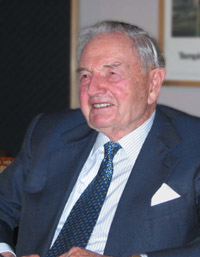
David Rockefeller. . . memoirist. The youngest of Abby Aldrich and John D. Rockefeller, Jr.’s five sons, alleged favorite of John D. Rockefeller’s grandsons, David Rockefeller became successful in his own right as head of Chase Bank, building it to international prominence. He has also known and interacted with many of the 20th century’s major political and arts figures. Mr. Rockefeller is the first of his renown American family to publish an autobiography, called Memoirs. In it, he offers a window on four generations of Rockefeller wealth, power and philanthropy. |
|
 3:51
3:51Having influence is not what is important. It is how
you use the influence that you have that counts, according to David Rockefeller.
He wants the name “Rockefeller” to be associated with citizens
who care about using their wealth in a constructive way that’s positive
for a broader society, not just for themselves.
David Rockefeller was for many years the CEO of Chase Manhattan Bank,
which he built to international prominence. He is also the youngest of
Abigail Aldrich Rockefeller and John D. Rockefeller, Jr.’s five
sons, brother of (Vice President of the United States) Nelson and (Governor
of Arkansas) Winthrop, and among Grandfather John D. Rockefeller,
Sr.’s favorites. David Rockefeller’s life-long interest
in history took him into the world, banking and the arts, and philanthropy
which combined all four interests. In his 88th year, reflecting on his
_Memoirs_, he thinks his multifaceted life may be of interest well beyond
his family.
“Citizen” is a constant thread David Rockefeller finds in
his life and family, along with their uncontested wealth and fame. By
the time America actively entered World War Two, the Rockefeller name
was long equated with Standard Oil. It was also inseparable from New York
City’s Rockefeller Center and the 75,000 jobs its construction created
in the depths of the Great Depression. The Rockefeller Foundation was
already important. Abby Rockefeller and two other ladies had already founded
the Museum of Modern Art . (Her son David has held fast to her vision
for almost 60 years on the MOMA Board.)
So why would Abby Rockefeller urge her youngest son -- exempt from the
draft as a married man with two children -- to go to war? Because,
says David Rockefeller looking back, Rockefellers are citizens. Yes, he
probably could have gotten a commission and a desk job in Washington.
But he was convinced that if you were going to participate as a citizen,
you should do it the way others did. He enlisted. Went through basic
training. Then officer candidate school. The Army put his fluency in French
to work in military intelligence, and kept him far from his family for
two and a half years.
But it was in war torn North Africa and Europe that David Rockefeller
learned a pivotal lesson. Talking to people -- and listening -- is how
you learn what’s going on. Mr. Rockefeller refined and enhanced
that skill, putting it to work leading his bank locally, regionally, nationally
and internationally, as a corporate citizen and as a private one. Mr.
Rockefeller’s “Rolodex” now exceeds 100,000 names, a
legacy of a lifetime in which he has known many of the leading figures
of the last half century.
Yes, David Rockefeller is aware of conspiracy theories in which his name
figures prominently. They are not true, he says simply, confident most
people understand. And, yes, he is proud of the Rockefeller name, as his
father and his grandfather were before him. In the end, it’s the
good one can create with one’s name, wealth and influence that matter
in life. Ask David Rockefeller.
[This Program was recorded November 12, 2003, in Atlanta, Georgia, US.]
 57:01
57:01


