|
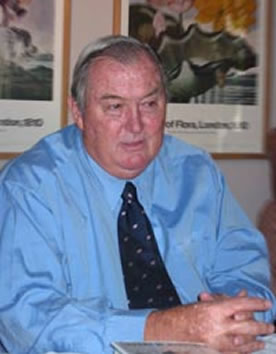
Richard Leakey
. . . paleoanthropologist and conservationist. Dr. Leakey is internationally
acclaimed for his work both finding our ancient human ancestors
and helping to prevent the extinction of African elephants. He is
now part of a growing number of people worldwide concerned about
the treatment and future of Great Apes -- chimpanzees, bonobos,
gorillas and orangutans, in addition to humans. As an environmentalist,
he also works to relieve human poverty and suffering as a critical
first step.
|
 3:49 3:49
|
Our descendants deserve at least a rudimentary chance
to survive and enjoy this planet as we have, Richard Leakey believes.
Will they get it? Dr. Leakey worries about the answer to that question.
Richard Leakey and his family have famously played key roles in understand
humanity’s origins. He is internationally acclaimed for his role
in saving African elephants from extinction. Now he is working on behalf
of other intelligent creatures including chimpanzees, bonobos, gorillas
and orangutans who, with humans, make up the Great Ape family. But
the current state of the world is far from satisfactory to Richard Leakey,
who sees more challenges than solutions.
There’s plenty of money in the world to address all of the many
competing demands, he’s convinced, concerned by what he sees as
a lack of political will to do so. He deplores isolationist tendencies,
deteriorated international relations and what he considers an artificial
crisis between Islam and the West, degradation of the environment and
large numbers of people falling into a poverty trap. But it is Global
climate change that casts its ominous shadow over all of our other very
real and present dangers for Dr. Leakey.
Our hope lies on our wonderful brains and our young, Dr. Leakey believes.
Young people need parents, not computers, DVDs and television. They need
to be listening to and participating in discussions about issues. Creating
stories. Questioning. They need real education that encourages openness
and flexibility that lasts a lifetime, not schooling that specializes
in multiple choice decisions with little or no understanding of the answers
given. Education is a fundamental problem that Dr. Leakey sees around
the world. We must give all young people opportunities to use their brains.
And being open to ideas must not stop at the school house door, Dr. Leakey
insists, both charmed and frustrated in particular by the United States.
The rest of the world may have values that are quite different and equally
legitimate to America’s, he points out, eager for Americans to resist
a troubling conviction that their way is the only way. Others, he maintains,
may prefer both another route and different destinations.
Addressing human misery and suffering is key, Dr. Leakey believes. Trapping
vast numbers of human in poverty and despair carries a cruel irony --
billions suffers while all of humanity is denied the abilities of potential
problem-solvers. New answers must and can be found. It is clear to him
that Marxism and what he calls bald capitalism must yield to a combination
of all sorts of ideas and theories that will be different in different
places.
The Leakey family was lucky, Richard Leakey concludes. They straddling
dramatically different cultures while searching for our ancient ancestors,
had opportunities to understand how things work in the natural context,
and were forced to accommodate differences. Now it’s our turn. The
judges will be our descendants, who must live with the consequences of
our actions.
[This Program was recorded February 13, 2004, in Atlanta, Georgia, US.]
|


 5:55
5:55