[This Program was recorded March 30, 1999, in Atlanta, Georgia, US..]
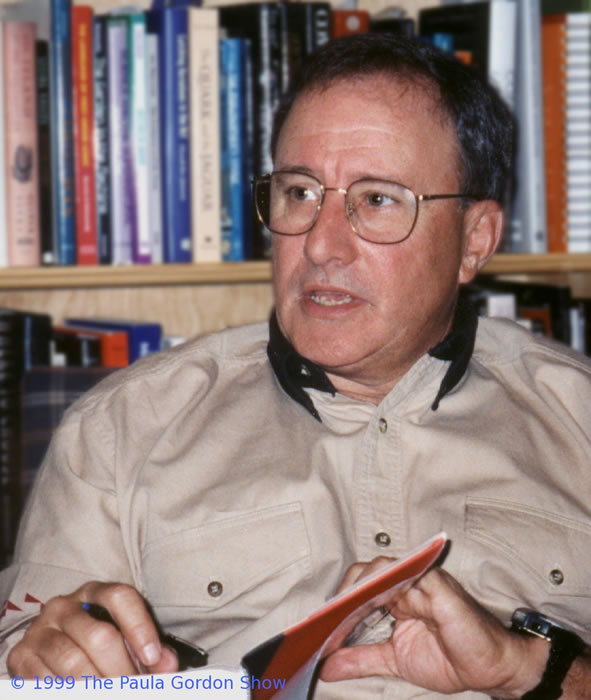 |
Danny Coulson |
| PAULAGORDON.com |
[This Program was recorded March 30, 1999, in Atlanta, Georgia, US..]
|
|
||||
|
Danny Coulson tells Paula Gordon and Bill Russell about grave law enforcement implications he (Coulson) sees around people's fear of change. Mr. Coulson talks about technological changes within the FBI. He suggests conspiracy theories are so rampant in part because they are so profitable. He confirms that the real stories of "the good, the bad and the ugly" are indeed much stranger than fiction.
|
Terrorism -- not weapons and destruction -- is the reason for the FBI's Counter-Terror Force. Mr. Coulson explains how important it is for law enforcement to deal with a criminal rather than creating a martyr (what results when a terrorist is killed), with examples including David Koresh. Coulson describes the tension between having a powerful law enforcement agency and an accountable one. He questions the independence of today's FBI investigations. He describes two FBIs - one inside the (Washington, DC) beltway, one outside it. He describes the relationship between J. Edgar Hoover, the FBI and the ill-conceived COINTELPRO. He draws a distinction between FBI headquarters and field agents. Using the Black Power movement, Coulson distinguishes between legitimate efforts for social change and crimes. Noting that most good ideas come from the field (not headquarters), he relates his experience in the FBI to business management issues.
|
|
Mr. Coulson summarizes the political circumstances that surrounded his departure from the FBI. He gives his insider's perspective on Ruby Ridge's political implications. He describes the attendant roles of Congress and the media. He points out the critical necessity to talk with people, whether Congresspeople, militia groups or ordinary citizens. He expresses his concern that Americans perceive government as a faceless enemy. He supports a stronger role for citizens, starting at the ballot box, worried that America's prosperity lulls us into complacency. He assures us that law enforcement people expect to deal with being second-guessed, drawing lessons from when he was the FBI's Congressional Affairs liaison, an experience which later helped him be a better commander.
|
Coulson tells why the concept of "No Heroes" should be the philosophy of a commander. He tells what distinguishes bravery from heroics, using Waco as an example of how not to do things. Because "Murphy" often arrives in crisis situations, Mr. Coulson expresses gratitude that sometimes FBI agents do act as heroes. He distinguishes between the functions of the military and law enforcers. He describes his path to a career with the FBI, based on a sense that even in the era of J. Edgar Hoover, there was a core urge to Do the Right Thing, coupled with the thrill of bringing to justice someone who threatened the community. Mr. Coulson applauds the vital role of an independent judiciary. He compares a "fix it" attitude to a "fix blame" one, with FBI examples. He contrasts people who are "drivers" to those who "go in." He compares the FBI under J. Edgar Hoover to today and expresses concerns about what Mr. Coulson believes is the FBI's current lack of independence.
|
|
The unknown-unknown (UNK-UNK) disrupts crisis situations, according to Mr. Coulson, who is concerned that people in government do not think enough about the consequences of their actions. He gives examples of why the best leaders are people who keep stress off of those who follow, confident that managers who put pressure on others are themselves weak. He describes the special energy of humans in conflict and shows how the leader's task is to direct that energy. He compares FBI agents to terrorists and describes them on a continuum, with terrorists not making the grade because they are inadequate people. He describes a typical FBI counter-terrorist agent's assignment. He tells how a potential law enforcement person turns toward terrorism. He uses examples to show how important it is for FBI agents and police to remember that they are cops, not commandos.
|
Enforcing laws is a fundamental part of a democracy which is based on the idea of justice, Mr. Coulson reminds us. He demystifies catching criminals. If we decide to make war on domestic terrorists, Coulson assures us the terrorists will win -- it becomes a civil war. Far preferable is to let the criminal justice system convert terrorists into criminals. Mr. Coulson applauds how the law governs most encounters, including the handling of the Oklahoma bombing investigation and arrests. The most important thing, he assures us, is to hold to the simple distinction between a commitment to save lives (the FBI's charge) and a commitment to take them (the military's job).
|
Danny Coulson's real life adventures, written in collaboration with Elaine Shannon, make great, and still topical reading. No Heroes: Inside the FBI's Secret Counter-Terror Force is published by Simon & Schuster. Mia Bloom reviews the history of terrorism and examines the current international condition of terrorism in Dying to Kill: The Allure of Suicide Terror. |
Acknowledgement
Danny Coulson combines a firey spirit with a remarkable friendliness and openness. We thank him for expanding our sense of a democracy's need for law enforcement -- directed by a commitment to save lives and act under the guidance of the Constitution, declining the lethal terms of engagement deemed appropriate to a military force.
|