The Paula Gordon Show Logo The Paula Gordon Show
Antibodies
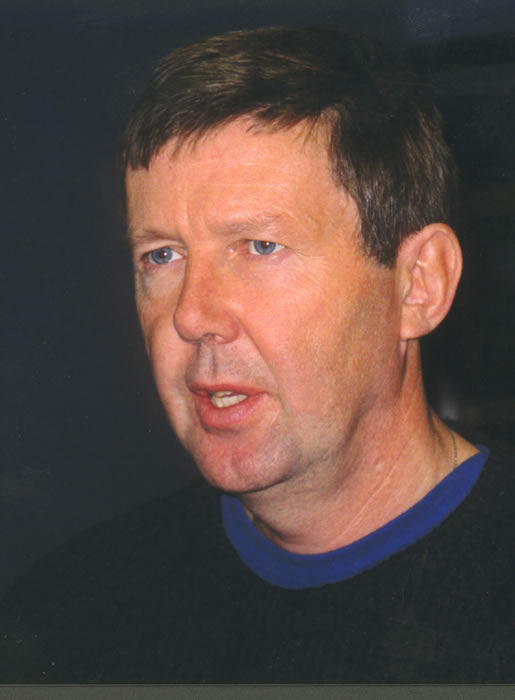
Dennis's Burton photo

Dennis Burton

      . . . is a virologist studying the antiöviral activities of human antibodies. As a Member and Professor at The Scripps Research Institute in the Immunology department, he has worked with HIV and Ebola. With an undergraduate degree in Chemistry fromÊOxford and a Ph.D. from Lund University in Sweden, Dr. Burton has worked in Europe, the United States and Australia. Among Dr. Burtonâs honors, he was Jenner Fellow at the Lister Institute of Preventive Medicine and received the NIH Merit Award for 1995-2005.

Excerpts4:17 secs

      Not long ago, infectious diseases were considered boring. Conquered. History. Then along came HIV, the AIDS virus. HIV was a wake-up call, says Dr. Dennis Burton of The Scripps Research Institute, where he studies the antiöviral activities of human antibodies. ÊHe says HIV research is driving a new understanding of pathogens, forcing researchers to address very basic issues in the interaction between pathogens and humans, to think deeply about how vaccines work in order to make better ones.

      Dr. Burton is an optimist about infectious diseases, in the face of HIV, Ebola and Hanta viruses with which he works. Pathogens, he says, are different from us. ÊThey have their weaknesses. Itâs the researchersâ job to attack those weaknesses. The questions are -- how quickly will researchers find the answers and how determined are we to do so? He fully expects there will be a lot of ups and downs, setbacks and catastrophes like the devastation AIDS has inflicted on Africa -- 40,000,000 orphans to date and untold social disruption. But we are making progress understanding the fundamental mechanisms of how antibodies work, Dr. Burton reports.

      While the marriage of biology and information/chip technology is producing all sorts of new and exciting possibilities, progress is the result of more than just advancing technology. Progress is coming from an entire toolkit of new ideas and approaches in the hands and heads of researchers, world-wide, all intent on understanding the fundamental processes of how pathogens and healthy organisms interact.

      It hasnât been easy. The classic approach to making vaccines -- mimic nature by altering the virus so it wonât cause disease, then vaccinate -- doesnât work with these new pathogens. Whatâs our best shot? The way Dr. Burton sees it now, antibodies that are preexisting in the body (the result of a vaccine) are pretty good at taking care of a problem when a pathogen passes by, less good at dealing with a pathogen once itâs taken hold. So -- stop the pathogen from getting the initial toe-hold. Hit at its weakest point, when it jumps from another animal or person. And (hereâs the best news) antibodies are good at that.

      The better we understand how nature works, according to Dr. Burton, the sooner weâll be able to respond quickly to outbreaks of diseases we have not seen before in humans. Simple enough? Well.... It requires excellent disease surveillance systems, world-wide; good public health delivery systems, world-wide; and a serious commitment to understanding the fundamental workings of science. Unfortunately, disease surveillance, public health and basic research are all ... undernourished.

      Figuring out how human antibodies do their job in the face of emerging pathogens is a high priority as international travel becomes commonplace and the human population explodes. The great advances in research, Dr. Burton reminds us, are often made by a tangential, unorthodox thought in the head of someone willing to be wrong.

Conversation 1

Dr. Dennis Burton summarizes his study of how our immune systems protect us against (emerging) viruses for Paula Gordon and Bill Russell. Dr. Burton distinguishes among viruses and various approaches to them.


Conversation 2

The advent of AIDS reawakened researchersâ concerns about infection diseases, says Dr. Burton, who gives a brief history of peopleâs awareness of old and emerging pathogens. He suggests what is and is not new and known about these diseases. He suggests where major problems arise in this study.ÊDr. Burton describes changes in the dynamics of pathogen-human interactions, greatly amplified by the swelling human population and increased travel. He describes similar phenomena in other species. He considers the devastating potential of diseases like AIDS.


Conversation 3

Dr. Burton describes how connected humans, other animals and pathogens are, using Mad Cow Disease as his example.ÊÊHe cites a variety of consequences for Britain and the rest of the world. He compares experience with this disease to our early experience with AIDS. ÊHe describes his own work with the anti-viral activities of human antibodies, starting with definitions, and explains how a research scientist approaches antibodies.


Conversation 4

Dr. Burton describes an Ebola infection. He explains what happens those who survive (approximately 25%.) He gives two reasons why researchers are interested in making neutralizing antibodies. He compares his work with Ebola and HIV. He recalls the research prompted by the 1995 outbreak of Ebola in Zaire/Democratic Republic of Congo and reports promising results of that research. He describes the underlying science, highlighting special techniques. He points out how critical a continuing increase in our general knowledge base is to such breakthroughs. He reminds us that there is a constant positive feedback in the whole scientific endeavor, with examples drawn from his own experience, across disciplines.


Conversation 5

Progress is being made against emerging pathogens, Dr. Burton assures us, with examples of how HIV research has driven a great deal of new understanding. He explains the basis for his optimism. He describes the enormous challenges AIDS has created in Africa. He uses small pox as an example of what could happen when a population is not (or is no longer) immune to a disease. Note is made of the work of DR. C.J. PETERS and the CENTERS FOR DISEASE CONTROL. Dr. Burton gives examples of the enormous benefits reaped from investments in science in America, comparing the American experience to Europe. He suggests why it might be that America has taken a lead in these endeavors. He connects the importance of research scientists and public health workers.


Conversation 6

Working across disciplines is an integral part of science, Dr. Burton believes, and uses his own experience to demonstrate this dynamic, ongoing process. He describes the scientific pursuit of natureâs Truth, offering his current view of the state of antibody studies. He reminds us of the vital role of a world-wide surveillance of diseases. He notes how often the great scientific advances are the result of tangential and unorthodox ideas, driven by questions, not answers.


Acknowledgements

Dr. C.J. Peters, Chief of Special Pathogens at the Centers for Disease Control and PreventionÊ(the CDC) in Atlanta, GA, introduced us to Dr. Burton and other renowned virologists while, simultaneously, meeting all his obligations as co-organizer (with Dr. Michael Buckmeier) of a virology conference in Taos, New Mexico. Dr. Petersâ enthusiasm for virology and his seemingly endless willingness to help the rest of us get a glimpse of whatâs at stake is a source of ongoing inspiration. Itâs always a pleasure to work with Dr. Peters and we thank him.

The people at the Taos Civic Plaza &ÊConvention Center were courteous and helpful at every turn. We are grateful to them all, especially Reuben J. Martinez, Facilities Superintendent, and Debbie Adamson, Sales &ÊMarketing Manager.

The town of Taos, New Mexico is a special place. We thank all of those who helped us.

Related Links:
Visit The Scripps Research Institute website for more information on the range of things Dr. Burton and his colleagues investigate.
Put another related link here


Quick buttons

© 2001 The Paula Gordon Show.
All materials contained on this website are
copyrighted by The Paula Gordon Show and may
not be used in any way without the express,
written consent of Paula Gordon.